


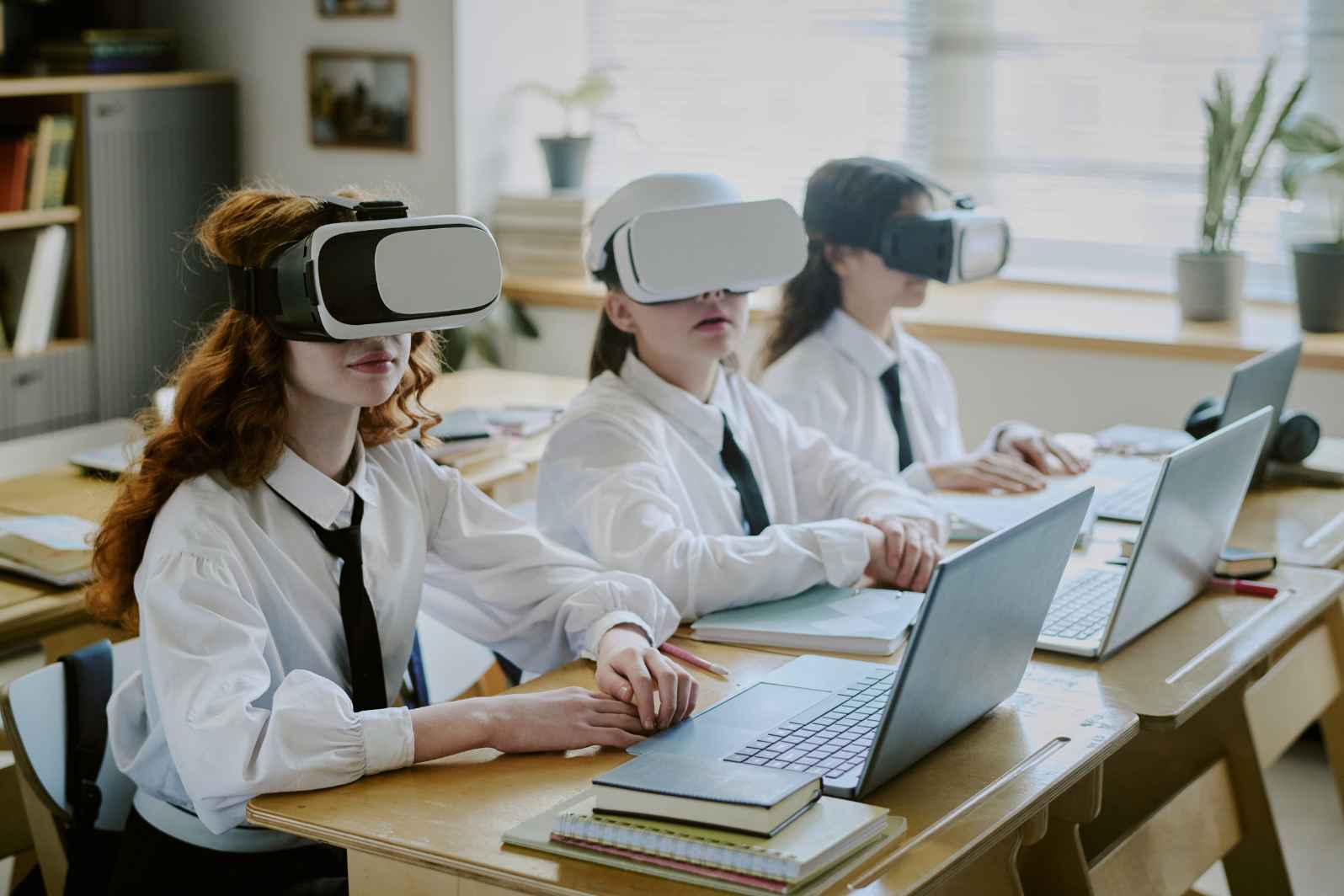
Education is changing, and technology is fuelling this change. Among all the new tools in the classroom, Virtual Reality (VR) is one of the most thrilling. It provides students with the opportunity to engage in immersive environments, navigate through complex ideas, and learn not possible by following traditional types of learning.
Learning becomes interactive, interesting and fun with VR. Instead of reading about history or science from a book, students can have experiences – walking through ancient cities, exploring the human body or even flying through outer space. Let’s look at some of the ways virtual reality is transforming education and student engagement worldwide.
1. What Is Virtual Reality in Education?
Virtual Reality simulates computer-generated 3D image or environment and is as if it is the real world. In education, VR enables students to work and learn in the real world as opposed to just learning theory.
It relies on headsets, sensors and interactive visuals to bring lessons to life. The OU claims VR makes everything more engaging and accessible to learn about, whether you’re covering off geography or art or physics.
Example: Students may put on VR headsets to take a virtual tour of the solar system and learn about planets as if they were astronauts.
The takeaway: VR makes learning an experience, not a chore you get through.
2. Espousing Fun and Engaging Learning
The traditional learning used books and lecture series, that sometimes would not be very interesting. Virtual Reality alters this by turning it into something exciting and interesting.
Students are engaged in their learning. When learning is an adventure, they listen more, remember better and pay attention.
Example: A history lecture can morph into a journey through ancient Egypt or the Indus Valley using VR.
The takeaway: When learning becomes an experience, students can remain more active and motivated participants.
3. Improving Retention and Understanding
Research shows that people remember much more when they learn by doing than by listening or reading. VR makes understanding the studies fun, interactive and easier to comprehend.
When kids can see and manipulate 3D models, difficult scientific & mathematical problems look like child play.
Example: A biology student can learn about the human heart in 3D, and even see how blood flows through its chambers in real time.
The takeaway: Virtual learning not only helps students understand deeply, but also remember longer.
4. Encouraging Active Learning
Active learning is described as the student being participants or active players of his/her education rather than acting as passive recipients of information. VR works towards that goal by tactile exploration and problem solving.
And students can carry out virtual experiments and instantly see the results rather than just reading about physics laws.
Example: A student in chemistry can mix virtual chemicals without danger of finding out which combinations might be explosive.
The takeaway: VR empowers us to experiment and discover.
5. Breaking Geographical Barriers
VR provides access to experiences that students could never have in real life. It bridges the physical gap, turning a classroom into an open and global community.
Museums, volcanoes and famous monuments around the world can be seen by students at their school desks. This way, all have access to global learning.
Example: A student in India can go on a virtual field trip to the Louvre Museum in France or study marine life in the Pacific Ocean.
The takeaway: VR democratizes any experience, anywhere in the world, for every learner.
6. Supporting Different Learning Styles
Every student learns differently. Some learn best by viewing, some by doing and others by hearing. VR can meet all learning styles.
It is a combination of (multimedia) visuals, (audio) sport and interactivity so that every type of learner will get the information better.
For example: visual learners may be able to capitalize on 3D animations, and kinesthetic learners are being engaged through movement and interaction in VR worlds.
The takeaway: With VR, education is more inclusive and effective for every learning type.
7. Building Collaboration and Communication Skills
Most VR platforms let students collaborate in shared virtual spaces. This promotes collaboration, critical thinking and communication skills.
“Group work on virtual worlds actually makes them learn to work in groups, even when they are not sharing the same space,” she said.
Example: Kids from schools across the city can gather in a virtual lab to work together on a scientific model.
The takeaway: VR enhances collaboration skills and lifts group learning out of the doldrums.
8. Increasing Motivation and Focus
VR limits distractions, because it immerses students in the lesson. When they are use their eyes and think, the concentration levels rise on its own.
Gamified VR classes also include challenges and rewards to make you feel like you’re playing an educational game.
Example: A geography lesson might also feature a quiz embedded in a mountain range, with students earning points for correctly identifying features.
The lesson: Students stay engaged and excited to learn with virtual reality when completing interactive activities.
9. Making Special Education More Accessible
VR can be a powerful resource for students in special education. It offers controlled, secure and personalised learning situations based on their comfort levels.
Students who have mobility or sensory limitations can also explore and learn, unhindered by their disability.
Example: A student with autism might learn social and communication skills by practicing them in a low-pressure situation such as a VR social simulation.
The takeaway: is that VR gives everyone a fair shot.
10. Preparing Students for Future Careers
Many careers of the future will be about technology, simulations and virtual collaboration. By using V.R. in schools, students get used to tools they might use professionally later on.
VR-based skill training is preparing students for careers in medicine, engineering, design and aviation.
Example: Medical students can perform virtual surgeries before actually doing so, and build up the confidence to do it right.
The takeaway: Students gain future-ready skills and confidence through VR education.
11. Reducing Learning Anxiety
Students then become fearful of making any mistakes and will be reluctant to talk or participate in the class. A headset offers such kids a place to practice and learn without judgment.
It also gives them confidence and lessens anxiety about trying to learn new curricula.
Example: One who is anxiety-ridden about public speaking can practice giving a presentation to be challenged with real people down the road.
The takeaway: The VR equipment allows children to learn without any discomfort and at their own pace.
12. Creating Cost-Effective Learning Experiences
Although VR hardware can appear costly, it becomes cost effective over the long term in an educational context. In place of regular field trips or physical materials, schools can turn to virtual labs and simulations.
This delivers equally good education at a lesser expense.
Example: Virtual chemistry laboratorys reduce costs for materials and keep students safe.
The bottom line: VR makes the advanced and visionary accessible to education.
Conclusion
The use of Virtual Reality is transforming learning and teaching. It makes for classrooms filled with inquiry, creativity and engagement.
By bringing lessons to life in a more visual, tactile way, VR makes learning something joyful and not just a chore.
As technology becomes more ubiquitous, Virtual Reality will be an integral part of the future of education. Because the more students interact with their lessons, the more they will comprehend, remember and be able to apply that learning out in life.
FAQs:
Q1. How does VR enhance engagement of students?
It turns learning interactive and immersive, fun to learn, students can concentrate more and understand in depth.
Q2. All Subjects: Can VR Be Used?
Yes. If used in science, history, geography and art, VR can really take learning to real-life experiences.
Q3. Is VR safe to use in schools?
Absolutely, as long as done in moderation and with guidance, VR is 100% safe for students.
Q4. Does VR replace teachers?
No. VR supports teachers by making lessons more engaging but cannot replace their guidance and human connection.
Q5. Can VR be used in schools with little money?
Yes. VR solutions and mobile apps are relatively inexpensive for schools on a reduced budget.
