


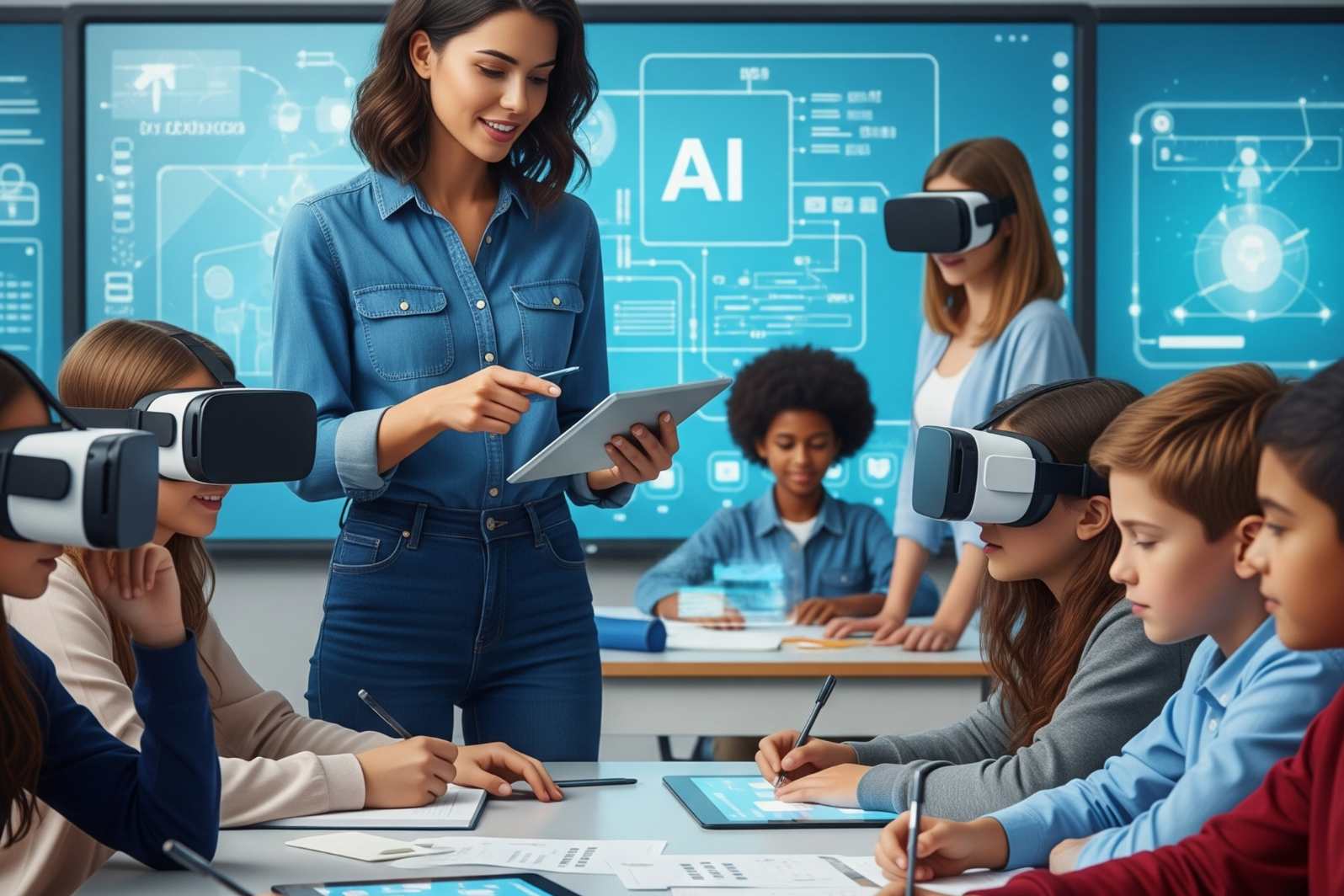
AI, also known as Artificial Intelligence is at the core of this new age – its innovation and infrastructure capabilities are affecting every industry from health care to education, comic books, to movie streaming services. In 2025, AI is also not just a tool, but a fundamental skillset that shapes how people work and think to solve problems. Teaching kids today for a future driven by AI is no longer an addition – it’s an imperative.
The world in which our children will be raised will bristle with intelligent systems, automation, and new kinds of jobs we can’t even imagine. So how can parents and teachers help children get ready for future careers in AI? Let’s delve into how to do it, in practical and age-appropriate ways.
1. Understanding Why AI Skills Matter
Artificial intelligence is changing every profession. Regardless of whether your child becomes a doctor, teacher, engineer or artist, AI-powered tools will be part of their work.
Nearly 70% of jobs will require AI literacy by 2030, industry experts say.
Learning about AI helps children:
- Develop problem-solving and analytical thinking.
- Learn technology rather than using it.
- Cultivate creativity and adaptability — skills that will be crucial for the future of work.
- So in other words, AI isn’t just for tech experts – it’s for everyone.
2. Start with Curiosity, Not Coding
A curious and exploratory spirit, not complex programming, is the best way to teach AI to kids.
Ask them questions, such as:
- How does Alexa recognize my voice?
- How does Netflix recommend shows to me?
- How does an autonomous car work?
These easy questions get him curious about how stuff works. As curiosity is piqued, kids become increasingly interested in learning the skills behind it.
3. Teach Computational Thinking
Coding and AI rest on computational thinking. It’s about solving problems in stages — much as computers do.
You can develop this ability away from the computer by nurturing activities such as:
- Solving puzzles and riddles.
- Playing strategic games, for example chess or Sudoku.
- Dividing complex jobs into bite-size, sensible parts.
Why it matters:
Computational thinking enables children to think logically and creatively — both necessary skills in AI-related fields.
4. Start with Coding (at a Fun Level) early
Coding is the language of AI. The younger children are when they become exposed to it, the more comfortable they feel.
Start with child-friendly platforms like:
- Scratch (ages 6–12): Aids kids in developing animations and games using easy drag-and-drop coding.
- Tynker or Code. org : Code with simple puzzles and challenges.
- Python (for older students): Often used for artificial intelligence programming because it is so simple and powerful.
Coding promotes logic, creativity, and perseverance — all of which are important towards AI innovation.
5. Encourage STEM Learning
AI jobs demand a solid grounding in Science, Technology, Engineering, Mathematics (STEM).
Have kids participate in STEM programs or workshops to learn robotics, electronics, computer coding and data analysis through hands-on activities.
Hands-on experiments — such as building a small robot or using sensors to measure light — make learning interesting and tangible.
Pro Tip: STEM education further nurtures your child’s ability to collaborate and problem solve – key skills in AI-led industries.
6. Introduce AI Tools and Games for Kids
A host of educational resources now make AI learning easy and fun:
- Google Teachable Machine: Enables kids to train their own A.I. models by uploading images or sounds.
- Cognimates: A platform where kids can make their own AI games and chatbots.
- Minecraft Education Edition: Learn coding and AI in a fun way.
- RoboMind: Teaches young students the basics of robotics and computer science.
These tools demonstrate for children how AI “learns” and responds, so that abstract concepts become quite concrete.
7. Soft Skills Are Just as Important as Tech Skills
To be sure, AI knowledge is necessary but human skills will be just as important.
Encourage children to develop:
- Critical thinking: To doubt and make sense of AI outputs.
- Creativeness: You have to be creative for developing cutting-edge AI solutions.
- Ethics: To use AI safely and fairly.
- Communication: For clearly communicating technical concepts.
Careers in AI will require a mix of logic, empathy and imagination.
8. Teach Ethical and Responsible AI Use
AI is potent, but it must be deployed thoughtfully. Concepts like privacy, bias and digital responsibility are ones children need taught, early on.
Explain that AI systems learn from data — and that data can be unfair or incomplete. Get them to realize that fairness, equality and responsibility are, at least for now, as important as innovation.
For example:
- Explain the ways that social media algorithms present different content to different people.
- Discuss the real-life impact of AI decisions, in hiring or health care.
Raising ethical thinkers promises a world in which technology works for everyone.
Encourage Creativity with Technology
AI is not all numbers and logic — it’s also about creativity.
Urge kids to think about how A.I. could be applied in art, music, storytelling or design.
For example:
- AI tools such as DALL·E can create digital art.
- Amper Music can write tunes with AI’s help.
- What kind of things can ChatGPT help kids write about?
That art/tech combination helps kids perceive artificial intelligence as a creative collaborator rather than just a machine.
10. Expose Kids to Real-World AI Applications
Demonstrate to kids what AI is already doing in their everyday lives:
- Voice apps (such as Siri or Alexa)
- Smart home devices
- Self-driving cars
- Online shopping recommendations
- Virtual classrooms and chatbots
And in learning how these systems function, kids begin to see the ways that A.I. is changing the world — and what part they can have a hand in playing.
11. Encourage Participation in AI Competitions
There are plenty of coding and robotics contests geared towards students too:
- FIRST LEGO League
- Google Code-In
- AI World Championship (AIWC)
- NASA Space Apps Challenge
These competitions prompt children to make practical use of their learning, work in teams and think creatively on deadlines — much like true AI engineers.
12. Build Lifelong Learning Habits
The AI industry evolves quickly. The most necessary skill you can impart to your child is the art of being teachable.
Encourage curiosity, reading, and experimentation.
Show your kids learning doesn’t only happen in school – rather, it’s a lifelong adventure involving all sorts of new tools and technologies.
Remember: The future is about learners, not knowers.
Conclusion
Getting kids ready for A.I.-heavy careers isn’t drilling them in coding when they are 5 years old, but doing the slow work of nurturing the skills, interests and love of learning that’s long been stifled out of many children.
Parents and educators can help prepare children to thrive in an AI-powered world, as they learn the basics of technology, practice problem solving, and exemplify responsible innovation.
The mission is not only to cultivate future engineers, but also future thinkers, innovators and ethical leaders who deploy AI for goodness.
FAQs:
Q1.When should kids start learning about A.I.?
Children can begin learning about A.I. and its concepts as young as 6–8 through games, coding apps and fun experiments.
Q2. Do K-12 students need to learn coding in order to grasp artificial intelligence?
Not immediately. Begin with critical thinking, puzzles and basic AI tools, rather than move straight to coding.
Q3. What should children study for the AI careers ahead?
Math Computer science Physics (Including Applied Math) Logic based ones are useful too.
Q4. How can parents promote A.I. learning at home?
Explore with learning apps, coding games and talk about where AI exists in day-to-day life.
Q5. Will AI replace human jobs?
AI will automate some jobs, yes, but it will also create entirely new ones that are as yet unimaginable and require values that only humans possess.
