


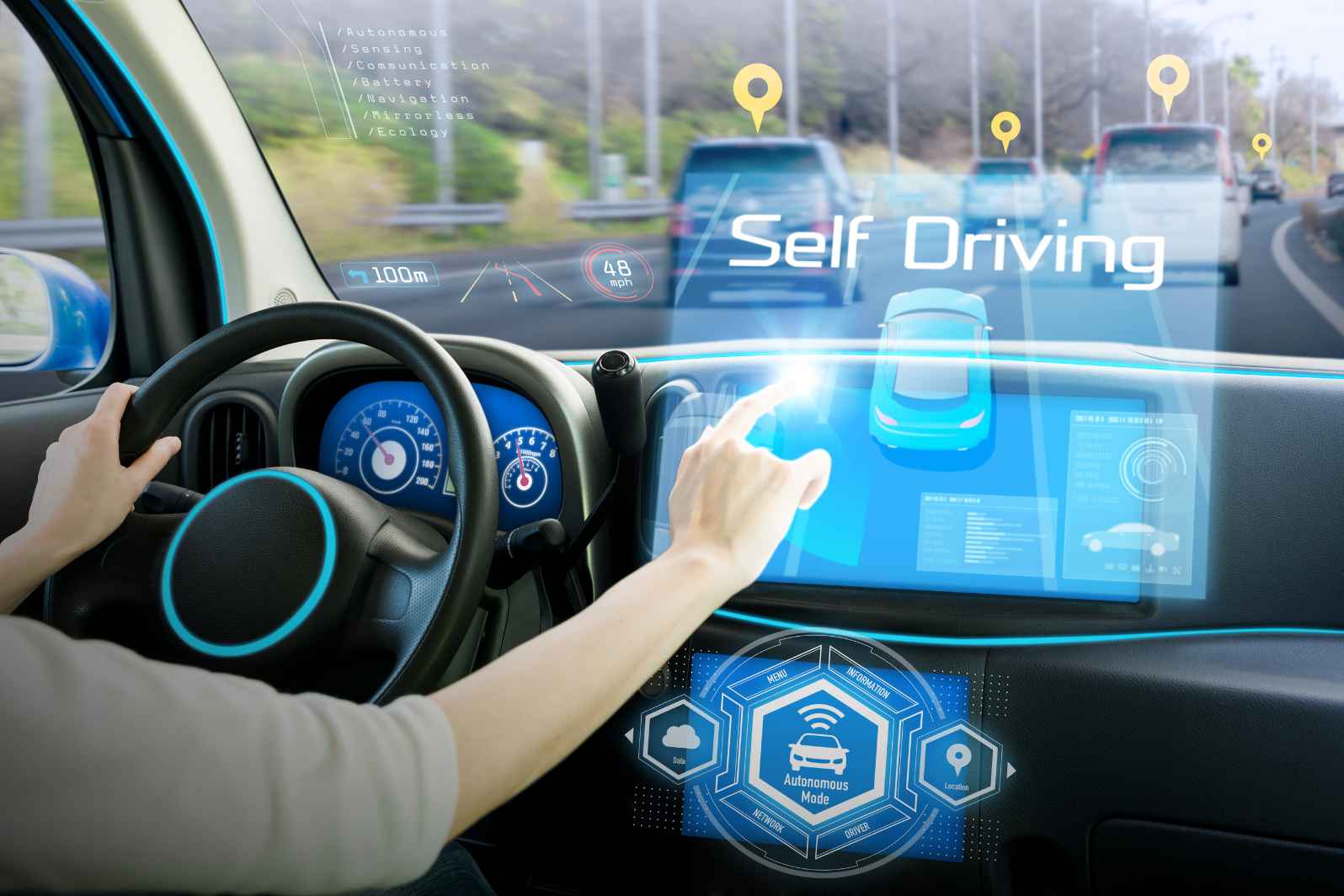
For years, the notion of cars that can drive themselves was generally seen as science fiction. And today it is on the way to becoming not fiction. Driverless cars are one of the most hyped-up new technologies around today, and for good reason: life would be much easier if we could start using them.
Fast forward to 2025, and self-driving technology is no longer a novelty — it’s in testing and use across multiple cities globally. But how soon can we expect driverless cars to really hit the road? Let’s find out.
1. What Are Autonomous Cars?
Self-driving cars are automobiles that can see the world around them and drive without human intervention. They rely on a mix of sensors, cameras, radar and artificial intelligence (AI) to perceive their environment, make decisions and travel safely.
Levels of vehicle automation There are five levels of vehicle automation:
- Level Zero: No automation (entirely human driving).
- Level 1: Low-level help (such as cruise control).
- Level 2: Additional driver assistance, but human attention still required.
- Level 3: Conditional automation (car can do driving tasks itself with conditions).
- Level 4: High automation (car can drive itself in most scenarios).
- Level 5: Full automation (no human interference whatsoever).
Currently, as of 2025, nearly all cars on the road are at Level 2 or 3; a few test models operate on Level 4 in predetermined settings.
2. The Technology Behind Self-Driving Cars
Self-driving cars are powered by a set of integrated technologies that enable them to operate, including:
- LiDAR (Light Detection and Ranging): Maps the environment in 3D with lasers.
- Radar sensors: Detect objects and determine their distance.
- Cameras: Recognize lane markings, traffic lights and pedestrians.
- AI algorithms: Process huge amounts of data to decide how to drive in real time.
- GPS and cloud computing: Assistance for route planning and coordination.
Together, these systems can give a car a full 360-degree view of its surroundings, helping it to navigate itself safely.
3. Current Progress in Autonomous Driving
Major automakers and technology companies are developing their autonomous vehicles with an eye toward full automation by 2025.
Key players include:
- Tesla: Keeps updating its Autopilot and Full Self-Driving (FSD) software.
- Waymo (by Google): Operating driverless taxi services in the United States.
- Cruise (by General Motors): Testing driverless rides in some cities.
- Baidu and Pony. ai: Pioneering China’s self-driving vehicles push.
Example: Waymo already has driverless taxis in action in Phoenix and San Francisco, where passengers can hail a ride without a human driver.
The progress is not bad, but it remains an arduous task to achieve the uniform autonomy.
4. Benefits of Autonomous Cars
A risk/benefit analysis of driverless cars is off the charts, like this:
- Safety: Most accidents are from human error, and automation could prevent most of them.
- Less traffic: Autonomous tech will work together to help coordinate cars in a way that avoids jams.
- More convenience: Elderly or disabled persons may find that they are now able to have increased independence.
- Fuel savings: Streamlined driving limits excess acceleration and deceleration.
- Less expensive transportation: Commuting can be cheaper when using shared autonomous vehicles.
In other words, self-driving technology might make transportation safer, smarter and environmentally cleaner.
5. Major Challenges to Overcome
Even as the technology has progressed rapidly, there are still several barriers before truly driverless cars become common.
Challenges include:
- Safety: AI needs to be able to deal with unexpected events, from road blocks and detours to pedestrians crossing the street.
- Regulation: Governments are still working out safety and liability laws.
- Public trust: Many people remain uncomfortable with surrendering full control to machines.
- Infrastructure: Roads, signals and maps will need to be redesigned to support driverless vehicles.
- Cost: The technology is still relatively expensive for mass production.
Until these challenges are overcome, we will still need a human to take the wheel.
5. Role of Artificial Intelligence
Every self-driving car has AI as its brain. It takes inputs from sensors and processes them in milliseconds, making instantaneous decisions to enable safe driving.
Machine learning models are trained with millions of hours of driving data, enabling cars to learn how to react in different situations — from city traffic to country roads.
Why it matters: The smarter AI gets, the safer and more reliable our self-driving cars will become.
Autonomous Public Transport and Taxis
Self-driving technology need not apply just to personal cars. Self-driving buses, delivery vans and taxis are already being tested.
Examples:
- Waymo One: A completely automated ride-hailing service.
- Nuro: Groceries and package delivery in self-driving vehicles.
- Yutong and Volvo: Trials of driverless buses follow fixed urban routes.
Effect: These systems could transform city transport, making it something more efficient, eco-friendly and open to all.
Government Policies and Legal Frameworks
Nations around the world are scrambling to devise laws for an emerging fleet of self-driving cars.
Examples:
- The U.S. has established state-by-state rules governing testing of self-driving vehicles.
- Europe looks ahead with ethics and safety guidelines on automation.
- The Indian government is working on laws so that driverless cards can be tested in safe environment.
Why it matters: Clear laws are crucial to the broad acceptance and safe use of autonomous vehicles.
Consumer Readiness and Market Growth
Public is interested in these autonomous cars/vehicles as technology gets better. But the surveys suggest a mixed response – excitement tempered with caution.
Market trends:
- The worldwide market for driverless cars is likely to surpass $600 billion by 2030.
- There are more hybrid models growing, of mixing automation with the human touch.
- Automation isn’t the only trend automakers are responding to : Car-sharing and subscription models are also on the rise.
Shoppers are slowly reorienting toward a future when cars think for themselves and act accordingly.
When Will We Have Cars That Are Truly Driverless?
Level 5 fully autonomous cars – those that require no human monitor and can drive anywhere — are still probably another 5 to 10 years away from being mainstream, experts say.
What’s next:
- Better AI and sensor accuracy.
- Improved laws and public infrastructure.
- More testing across various weather and traffic conditions.
By 2030, we could be seeing self-driving cars as a fixture in public transit within major cities.
Conclusion
Self-driving cars are no longer a fantasy of the distant future – they’re here already, it’s just that some of these early versions still have room to improve. Although safety, cost, and regulation issues persist, the technology is still rapidly developing.
“You don’t need to replace human drivers 100 percent,” he said, echoing many in the industry. “The goal is not full autonomy – It’s achieving a better and safer and more efficient driving experience.”
With AI, sophisticated sensors and international cooperation, the world is on the cusp of self-driving cars.
FAQs:
Q1. How much automation do cars have today?
Level 2 or Level 3 is where most carmakers stand today, providing partial automation like lane assist and adaptive cruise control.
Q2. Is there a fully driverless car on the market?
Only in limited areas. They are being tested by companies like Waymo and Cruise in some cities.
Q3. What is the greatest obstacle to driverless cars?
Safety, rules and public trust are the main hurdles to full adoption.
Q4. Is there going to be a complete replacement of cars?
Not soon. There are and will continue to be humans required for difficult decisions and oversight for years to come.
Q5. When will driverless cars be the norm?
They predict widespread use by 2030 to 2035, subject to advances in technology and the law.
